

If you’ve been dealing with jaw pain, clicking, or tightness in your face and neck for a long time — and nothing seems to fully fix it — you’re not alone. TMJ disorders are notoriously stubborn. Mouth guards help a little, physical therapy helps a little, but the relief never quite sticks.
Here’s something that doesn’t get talked about enough: for some people, TMJ isn’t just a structural problem. It’s also an immune system problem.
In my practice, this connection shows up constantly. About four out of five patients I see for TMJ come in with an existing autoimmune diagnosis. It’s not a coincidence — it’s a pattern. And once you understand it, a lot of things that seemed confusing about your jaw pain start to make sense.
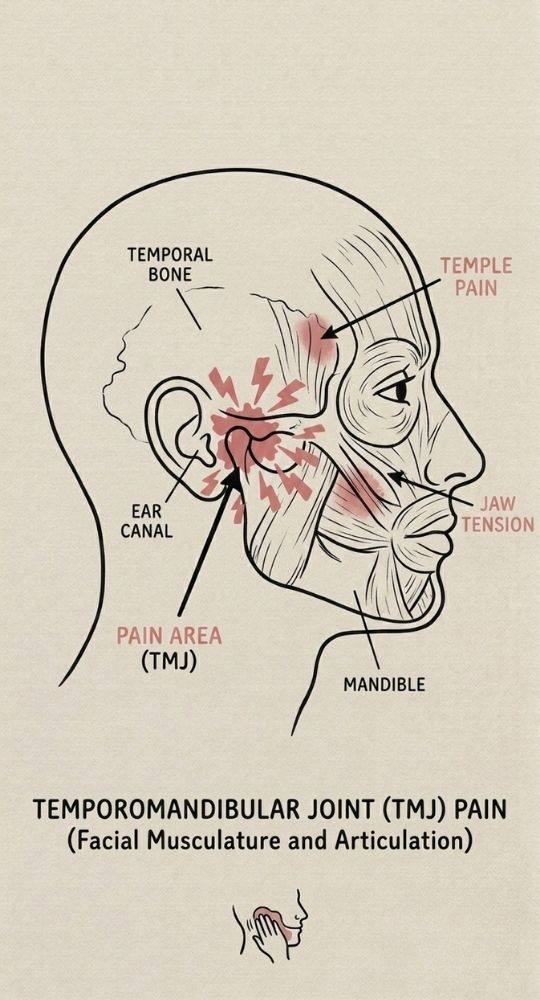
TMJ Disorder
TMJ stands for temporomandibular joint — the hinge joint that connects your jaw to your skull. You have one on each side, just in front of your ears. When people say they have “TMJ,” they usually mean TMJ disorder (sometimes written as TMD): pain, clicking, locking, or dysfunction in that joint and the surrounding muscles.
Common symptoms include:
• Jaw pain or soreness, especially in the morning
• Clicking or popping when you open or close your mouth
• Headaches, especially at the temples
• Ear pain or fullness without an infection
• Neck and shoulder tension
• Difficulty opening your mouth wide
Most people are told it’s from stress, clenching, or a bad bite. And sometimes that’s true. But for a significant portion of TMJ sufferers, inflammation — driven by the immune system — is playing a major role.
Several autoimmune conditions are directly associated with TMJ inflammation and dysfunction. The joint itself has a disc, cartilage, and synovial fluid — just like your knee or hip — which means it’s just as vulnerable to immune-mediated inflammation as any other joint in the body.
RA is one of the most well-documented causes of TMJ involvement. Research shows wide variability in prevalence estimates — from around 20% in early disease to over 60% in long-standing RA — in large part because jaw pain isn’t routinely assessed in rheumatology settings and often goes unreported. RA causes the immune system to attack the synovial lining of joints, leading to inflammation, bone erosion, and eventually changes in how the jaw moves and feels.
Sjögren’s is often thought of as a “dry eyes and dry mouth” condition, but it’s actually a systemic autoimmune disease that affects moisture-producing glands throughout the body. The connection to TMJ is twofold: the joint itself can become inflamed, and reduced saliva flow alters chewing mechanics and jaw muscle function in ways that contribute to pain and tension over time.
Lupus causes widespread inflammation throughout the body, and the joints are frequently affected. TMJ involvement in lupus patients — including condylar erosions, joint pain, and restricted opening — is documented but underreported, in part because jaw symptoms are rarely the presenting complaint. The unpredictable, flaring nature of lupus can make TMJ symptoms feel confusing and disconnected from the larger picture.
Both of these spondyloarthropathies affect the spine and joints and can involve the TMJ. Ankylosing spondylitis has a strong association with the HLA-B27 gene (present in 90–95% of AS patients), and TMJ stiffness in these patients often mirrors the morning stiffness they experience elsewhere. Psoriatic arthritis can also affect the TMJ — sometimes as an early or even presenting sign — with symptoms including jaw pain, pre-auricular swelling, and restricted opening.
Not everyone with autoimmune-driven joint inflammation has a clear diagnosis. UCTD is a recognized condition in which people have autoimmune markers and symptoms without meeting the full criteria for a specific disease. TMJ pain is one of the ways this shows up, often alongside fatigue, joint aches, and skin or hair changes.
There’s something worth naming that I see often in the clinic. When you’ve had an autoimmune condition for years — maybe decades — it has a way of becoming part of the background. You manage it, you work around it, you learn what your bad days look like. It stops feeling like a crisis and starts feeling like just… you.
Which means that when you come in for jaw pain, the autoimmune condition might not even come up. It’s not that you’re hiding it — it’s that it doesn’t feel relevant anymore. It’s in the background. The jaw is the problem.
But here’s what I want you to hear: just because something has been with you for a long time doesn’t mean it can’t change. And it doesn’t mean you have to accept the current level of symptoms as permanent. An autoimmune condition being “part of you” doesn’t mean it’s fixed in place. There is real ground to be made up — in how your immune system is expressing itself, in how your body feels day to day, in the concrete quality of your life.
The jaw pain is often a useful entry point, actually. It’s the thing that finally brings someone in. And once we start working on the whole picture, people frequently find that other things they had quietly accepted — the fatigue, the stiffness, the unpredictable flares — start to shift too.
If you go to a dentist or oral surgeon for TMJ, the focus will almost always be on the jaw structure: the bite, the disc position, the muscles. That’s a completely reasonable place to start. But if inflammation is the underlying driver — and that inflammation is coming from your immune system — no amount of adjusting your bite or wearing a night guard is going to fully resolve it.
This is part of why so many people cycle through multiple treatments without lasting relief. The jaw is being treated as a local mechanical problem when it’s actually a local expression of a systemic one.
The same limitation can apply even within acupuncture when it’s used in isolation. I’ve seen many patients who get real relief from acupuncture treatments, but find themselves coming back every two to four weeks indefinitely — never quite breaking the cycle. The acupuncture is managing the symptoms, but without addressing the underlying immune and systemic drivers, it can’t create lasting change on its own. That’s not a failure of the medicine; it’s a sign that a more integrated approach is needed.
In Chinese medicine, joint pain that wanders, flares unpredictably, and involves heat and swelling is often understood through the framework of Bi syndrome — obstruction of Qi and Blood in the channels and joints. The autoimmune pattern adds another layer: an underlying deficiency (often of Yin, Blood, or Wei Qi) that makes the body susceptible to deeper, more entrenched inflammatory patterns.
The jaw sits at the intersection of several important meridians: the Stomach, Gallbladder, Small Intestine, and Triple Warmer channels all run through this area. It’s also intimately connected to the Liver system in Chinese medicine — the Liver governs the sinews (tendons and ligaments) throughout the body, and emotional stress is understood to directly impact Liver function and therefore jaw tension.
What this means clinically is that treating TMJ from a Chinese medicine perspective isn’t just about needling the local area. It means addressing the inflammatory pattern, supporting the underlying deficiency, and working with the nervous system and emotional patterns that keep the tension locked in.
When I work with someone whose TMJ has an autoimmune component, treatment looks different than it would for someone with stress-related clenching — and meaningfully different from acupuncture alone. The integrated approach is what allows us to move from managing symptoms to actually shifting the underlying pattern. It tends to involve:
• Acupuncture targeted at both local jaw points and systemic inflammatory and immune-regulating points
• Chinese herbal formulas that address the specific inflammatory pattern (heat-clearing, damp-resolving, or Blood-nourishing depending on what’s driving it)
• Attention to the gut-immune axis — because a significant portion of immune regulation happens in the digestive system, and supporting gut health is often part of managing autoimmune flares
• Lifestyle and dietary guidance to reduce inflammatory triggers
• Nervous system support, since the immune system and nervous system are deeply intertwined — chronic stress fuels inflammation, and calming the nervous system is part of calming the immune response
The goal isn’t to suppress the immune system — it’s to help it regulate itself more effectively. And when all of these pieces are working together, patients typically find they need less frequent treatment over time, rather than returning indefinitely to maintain a baseline.
You don’t need a confirmed autoimmune diagnosis for this to be relevant. Consider whether any of the following resonates:
• Your TMJ symptoms flare alongside other body-wide symptoms (fatigue, joint pain elsewhere, skin changes)
• You have a known autoimmune condition and your jaw is just one more thing that’s been bothering you
• Your jaw pain has a heat quality — it feels warm, inflamed, or worse in hot weather
• Standard TMJ treatments have given you partial relief at best
• You have a family history of autoimmune disease
If you’ve been treating your jaw in isolation and not getting lasting results, it might be time to zoom out. Acupuncture and Chinese medicine are well-suited to this kind of complex, systemic problem — not because we have a magic needle point for TMJ, but because the medicine is designed to treat the whole person, including the patterns underneath the symptoms.
I offer initial consultations where we can take a thorough look at your health history, talk through what’s been tried, and figure out whether this approach makes sense for your situation.
This post is for educational purposes and does not constitute medical advice. If you have or suspect an autoimmune condition, please work with a qualified healthcare provider.
The following peer-reviewed sources informed the clinical and scientific content in this post.
1. RA & TMJ prevalence (variability across disease stages): Agrawal A, et al. “Temporomandibular Joint Involvement in Rheumatoid Arthritis: A Neglected Entity.” Indian Journal of Rheumatology. 2025. Link
2. RA & TMJ prevalence (50% clinical evidence): Akhlaghi M, et al. “The Prevalence of Temporomandibular Joint Involvement in Rheumatoid Arthritis Patients.” Rheumatology Research. 2019; 4(4). Link
3. RA & TMJ prevalence (70% majority affected): Aloyouny A, et al. “Prevalence and Severity of Temporomandibular Disorders in Rheumatoid Arthritis Patients.” International Journal of Environmental Research and Public Health. 2022. Link
4. TMJ underdiagnosis in RA — not routinely assessed in rheumatology: Aloyouny A, et al. “The Prevalence of TMD Related to Rheumatoid Arthritis is Underestimated.” International Journal of Environmental Research and Public Health. 2022. Link
5. Sjögren’s, RA, and AS — TMJ symptoms across autoimmune conditions: Yildızer Keriş E, et al. “Temporomandibular Joint Findings in Patients with Rheumatoid Arthritis, Ankylosing Spondylitis, and Primary Sjögren’s Syndrome.” Journal of Investigative and Clinical Dentistry. 2017; 8(1). Link
6. Sjögren’s — orofacial muscle function and TMD: Zanin C, et al. “Orofacial Motor Functions and Temporomandibular Disorders in Patients With Sjögren’s Syndrome.” Arthritis Care & Research. 2020. Link
7. Lupus (SLE) — TMJ involvement including condylar erosions: Crincoli V, et al. “Temporomandibular Disorders and Oral Features in Systemic Lupus Erythematosus Patients.” Medical Sciences. 2020; 8(1). Link
8. Lupus (SLE) — TMJ symptoms in one-third of patients: Jonsson R, et al. “Temporomandibular Joint Involvement in Systemic Lupus Erythematosus.” Arthritis & Rheumatism. 1983; 26(12). Link
9. Psoriatic arthritis — TMJ as presenting sign: Halabi M, et al. “Temporomandibular Joint Involvement Revealing Psoriatic Arthritis: A Case Report.” PMC / Case Reports in Rheumatology. 2024. Link
10. Psoriatic arthritis — clinical features of TMJ involvement: Al-Ezzi MY, et al. “Temporomandibular Joint Disorders Associated With Psoriatic Arthritis: A Report of Three Cases.” Cureus. 2023. Link
11. Ankylosing spondylitis — HLA-B27 and TMJ involvement: Farrar M, et al. “Involvement of the Temporomandibular Joints in Ankylosing Spondylitis.” British Journal of Oral and Maxillofacial Surgery. 2005. Link
12. TMJ involvement across RA, SLE, and systemic sclerosis: Aliko A, et al. “Temporomandibular Joint Involvement in Rheumatoid Arthritis, Systemic Lupus Erythematosus and Systemic Sclerosis.” Oral Surgery, Oral Medicine, Oral Pathology, Oral Radiology. 2011. Link
13. Comprehensive review — TMJ manifestations across autoimmune conditions: Al-Harbi H, et al. “Temporomandibular Joint Manifestation of Autoimmune Diseases.” The Saudi Dental Journal. 2026. Link

